





“Hallo!”
The word came out of the fog, followed only a second or two later by the
vague outline of the man who had shouted it, the more substantial outline of a
building of some description behind him, and a smudge of grubby yellow-orange
which seemed to be hanging in shaky suspension next to his head. It was only as I
took a couple of blundering steps toward him that I realised it was a lamp.
Those two blundering steps were on account of the panic I’d been gripped by
during the last – how long? – hour? Two hours? Longer? Disorientation had gone
hand-in-hand with panic: they’d fed off each other; permeated me like the fog and the
cold. And for all that the night was freezing, a clammy sweat had added its own layer
between my skin and my clothing. I’d started shaking at some point, as well.
I’ll admit that for a moment I took the whole thing – the voice, the figure, the
building – for an hallucination. Even wondered if I were already dead and this just
some fugue between one state of being and whatever’s beyond. Then I took those two
steps, during which time he called out again – “Hallo! Hallo!” – and I picked up my
feet and began moving faster, more purposefully.
“Take it steady,” he counselled, still standing there, lamp held out in front of
him. “The land slopes off suddenly. You could easily fall. Come down slow, in a zig-
zag.”
I heeded his advice and stepped cautiously. He remained dead still during the
few minutes it took me to navigate the terrain, and I was grateful for it – he provided
me with a fixed point. The land levelled. A few more steps and I could see him
clearly. He was tall and his face pale. His clothing was nondescript. His hair was dark,
rat’s-tails curling out from beneath a flat cap. It occurred to me to wonder how I
looked to him; how inappropriately kitted out for the terrain and the time of night.
I put the thought from my mind and thrust my hand out. He shook it. “There’s
a stove in the box,” he said. The phrase struck me as incongruous and I was about to
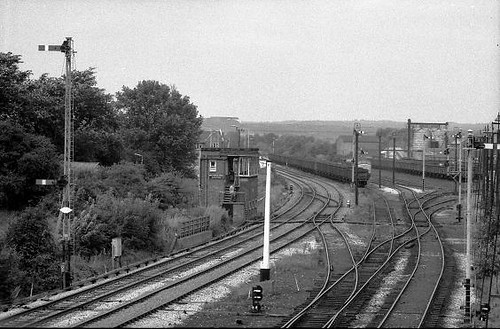
ask him to repeat it when he turned and started up a creaking set of steps and his lamp showed enough detail of the building that I realised what he meant. It was a signal-
box.
The stove was a godsend. He pulled a stool over and I sat. “Bad night to be
out,” he said, and leaned against the wall in a manner that indicated the stage was
mine and he couldn’t wait to hear how I’d got my damn fool self lost.
So I told him.
I told him about the argument with my fiancée, the words said in haste, and
the ring flung back at me with equal rapidity. I told him about the drinking and the
problems at work. I told him about the senior partner advising me in no uncertain
terms to take a week off, go somewhere, clear my head and bloody well make sure I
returned with a healthier attitude and sharper attention to detail. I told him how I’d
picked a destination based on its remoteness and bought a train ticket. Taken a room
at the first place I saw with a ‘vacancies’ sign, and headed for the nearest pub. Nearest
in this neck of the woods being something of a relative concept. It was actually in the
next village. My thinking, I explained, was that it would only take me two or three
days to clear my head, leaving me the better part of the week to get it addled enough
to making the clearing worth the effort.
He nodded at the logic of this.
I wound up the narrative: the early evening meal courtesy of my landlady, the
walk to the pub, the several pints of strong local ale, the balmy evening air and mild
temperature that persuaded me to wander off up a gentle incline, the better to take in
the scenery, rather than walking back the way I’d come. The incline that became
steeper. The mild temperature that plummeted. The balmy evening air that
transformed, as if on a whim, into thick fog. The immediate loss of direction. The
panic.
“What pub did you set out from?” he asked.
“The Farrier’s Arms.”
“Upper Thrampton,” he said, nodding again. “And the guest house?”
“The Elms, Low—”
“Lower Thrampton. Aye.” He raised an eyebrow and blew out his checks.
“You’re a good five miles from either.”
“I don’t suppose you’ve got a torch?”
“Even if the fog lifts, a torch won’t do you much good. There’s nothing in the
way of landmarks I could direct you by. Round here, you either know the land or you
don’t.”
I got up from the stool and went to the window. An inch beyond the glass, the
fog hung like a heavy curtain. “And it’s not even going to lift any time soon, is it?”
The window held a faint reflection of him. I could make out that he was
shaking his head. “Your best bet is to kip here,” he said. “Use your coat as a pillow.
There’s an old blanket you can pull over you. I’ll keep the stove banked up.”
“What about you?”
“No sleep for me. I got a lamp to hang and these—“ he ran his hand along the
bank of levers that lined one wall of the signal box “—to attend to.”
“Thanks.” It wasn’t ideal, and part of me baulked at bedding down in the
presence of a stranger. But I told myself not to be so squeamish or selfish. Besides, it
wasn’t as if I had any other choice. “Thanks,” I said again, and hoped I sounded more
grateful this time.
I took his advice and rolled my coat up. I did my best to find a comfortable
position on the hard floor, and took the offered blanket. It smelled musty and felt
scratchy, but it was warm. I dozed within minutes.
It was a fitful sleep, though. I woke first from a dream of being lost in the fog
again – woke with a start. The motion did not seem to disturb the signalman from
whatever reverie occupied him: he was gazing out of the window with such intensity
that I thought for a moment the fog had cleared and there was something in the view
that had particularly captivated him. But the fog was still there and I closed my eyes
and slid back into unconsciousness. The second time I woke, I was aware that I was
alone in the signal-box. A shape at the window startled me, then I remembered he had
spoken of hanging a lamp. An ache in my shoulders and lower back dissuaded me
from giving any more thought to the practicalities of lamp-hanging, and I shifted
around, trying to tuck the blanket partly under me, until I was comfortable enough to
sleep again.
My third awakening was to the thunder of a train passing. The noise was
phenomenal. Its whistle was a scream. The entire signalbox shook. My host sat
placidly throughout, swigging tea from a tin mug.
“There’s enough for two,” he said, noticing that I’d sat up.
I nodded acceptance.
He fetched a spare mug and poured tea into it. I accepted it gladly. It was
scalding hot and so strong it brought tears to the eyes. He pulled the stool closer to the
stove. “Is there anyone waiting for you at The Elms?”
I hesitated, then said: “Back home, yes; but not at The Elms.” It was a lie: I no
more had anyone waiting for me anywhere than I’d just slept in silk sheets. But the
way he’d asked seemed curious. I couldn’t tell whether he was concerned that
someone might be worrying about my having met with a bad end, or ensuring there
was no impediment to fulfilling it himself.
“It’s the loneliness that gets to you.” His eyes drifted away from me, back to
the window again. “Time isn’t so bad, just little cubes of it like dice. Aye, just like
dice. Each with a number on the side. Just as long as you don’t throw ’em like dice or
muddle the order. Just as long as you keep ’em neatly lined up. Count six little cubes
and hang the lamp. Count two more and throw a lever. Keep everything in the right
order. Do everything at the appointed time.”
I yawned and tried to stifle it.
“And don’t nod off at the wrong time,” he added, with a smile pushing at the
edges of his lips that had no warmth in it. “Little cubes of time, that’s all this job is.
The right order, the appointed time. It’s the loneliness that gets to you, though.”
He replenished the stove and it occurred to me to ask what time off he had.
There were dozens of questions, my mind thick and muddled with them. But the heat
was muzzy and my eyelids drooped. My head slumped onto the pillow of my coat and
I slept and strange ideas crept through my dreams but none of them were strange
enough to wake me
What woke me was the cold.
The stove had gone out. The signal box was silent. The only slight noise came
from outside and a long way off at that. It might have been the bleating of sheep on a
hillside. I rubbed my eyes and it took a second or two to focus on my surroundings.
The signal man was sitting in a corner, legs pulled up so that his knees touched his
chin. Arms wrapped round his legs, he appeared to be rocking slightly. His skin was
so pale it was as if he had blended in with the institutional white paintwork of the
signal-box’s interior. I sat up, intending to ask him what was wrong. My shoulders
and back flared with pain and a grunt of discomfort choked off the words I was
formulating.
“You’d best get the stove going again,” he said, looking anywhere but at me.
“It’s a hell of a long shift and for that I’m sorry.”
He grew paler still. His form became indeterminate. Part of me wanted to
scramble toward him, reach out, pull him back from whatever was taking him. Part of
me was struck rigid with disbelief. And, yes, I’ll admit it: part of me was terrified.
“I wouldn’t go outside,” came the dry whisper from what was left of him; “at
least not far. Wherever you go, it’ll point you back here.”
And then he was gone.
My paralysis broke and I threw myself across the signal-box and pushed
against the door and then hammered and tore at it in desperation when it wouldn’t
give. A sudden embarrassing jolt of rational thought told me that it opened inward not
outward and I pulled instead of pushing and felt like an idiot as it obliged. Then I was
moving at speed, almost overbalancing on the steps. I hit the ground at a run. The cold
had dissipated and the fog was lifting. It was getting lighter. I was able to divine the
ruts and rises in the landscape. I’d be able to keep moving forward without drifting in
the wrong direction as I’d done in the darkness last night.
It came at me before I’d gone fifty yards.
It was insubstantial, a wisp of a thing. Like a sheet eaten away by moths, a
piece of fabric somewhere between dark grey and black. A piece of fabric in the
almost-shape of something human. Or inhuman. The crazed thought flashed through
my mind that the Turin Shroud would be like this if it had a devil’s face, not Christ’s.
The thought set panic pumping through me. My mouth was dry. My heart hammered.
I batted the thing away, or tried to. It spun, making a whirlwind of itself, with me at
the eye of its storm. It created a heavy wind that slapped at my face and the stench
accompanied it was as if a grave had been opened.
I dropped to the ground, head down, hands over my face. Not seeing helped,
but the sensation of that horrible breeze and the whirring noise as it spun drove me to
desperation. I pulled myself up into the position of a sprinter on the starting block. I
held my breath and closed my eyes. On a mental count of three, I launched forward
and passed through it. The pain was ferocious, though when I put my hand to my face
it came away coated with a thin oily film, but no blood. There were little bits of dark
material within the oily fluid that I tried not to think about.
Not that I had much opportunity to think. I’d got off to a fast start, but I’m no
athlete and the pace left me exhausted and nursing a stitch. I’d only run for a few minutes; now I was bending over, hands gripping my legs just above the knees,
breaths coming shallow and ragged. I risked a look back and saw nothing. Sweat
helped drip the oily film into my eyes and I wiped them with the back of my hand. I
was aware that the stuff had got into my nose and mouth. That was enough for my
system to rebel. I was in the right position to be sick, and I vomited until my throat
hurt. My arms were shaking and my legs felt like they were about to give out. My
eyes watered. I spat a couple of times then wiped my eyes again as I straightened up.
It was just a few feet in front of me, holding its position.
Pointing.
Pointing me back to the signal-box.
I lurched to the left and ran, the stitch in my side shrieking its protest
immediately. I slipped and went down, swearing as I jarred my shoulder. It dived
towards me as I got up. I threw myself back on the ground, rolled, sprang up as soon
as I was sure of my footing. Its filthy smell was close and the air was full of the sound
of it. Like a wasp too close to the face. In my right ear; deafening.
I flung myself left again, increasing the pace. The sound diminished. My feet
hitting the ground became the one thing I could consistently hear. I gulped down huge
breaths and the air tasted fresh. My nostrils filled a vague marshy smell that I assumed
was the fog. There was a sense, just beneath it, of the mushroomy tang of the earth.
Then everything was replaced by carrion and darkness and that oily texture
that felt intimate in a way that would have made me retch again if there had been
anything left to expel. It came at me, faster than I’d have thought possible – even for
the impossible. It came from every angle and direction. It whirled about me, slapped
at me, threatened to shaped its contours around my face and stifle me.
I flailed and clawed at it, screamed and pleaded, tried to sidestep, retreat,
move this way and that, but only succeeded in tripping myself. I pulled myself into a
quivering pathetic ball on the mossy ground and waited till it killed me or I lost my
mind, whichever happened first.
I’m not sure, but I think I passed out. When I finally pulled myself together
and got to my feet, my clothes were soaked through. I wondered if it was dew or
whether I’d soiled myself. I wondered where the thing had gone. The sun was up. The
fog had burned off. I could hear a train somewhere in the distance. It wasn’t a
comforting sound.
Shakily, I started walking in a direction that corresponded with a diminution
of the train. The railway line meant the signal-box and I didn’t care which way I
walked as long as it was away from there.
Every footfall was painful. My hamstrings felt like a maniacal piano tuner had
been set loose on them, my calves as if they’d been imprinted by a thousand branding-
irons. I was aware of my own aroma; I probably had voided myself. My mind buzzed
as I walked. There was sense to be made of all this – I clung onto that – but my mind
was busy ransacking a storeroom of childhood fears, recurring nightmares and cheap
novels. Trying to find points of reference. Trying to find something cosy in the
inexplicable.
The ground rose and my feet and legs protested. I plodded forward. The
incline was mercifully brief. The terrain levelled and I saw a road ahead. My mind
dumped a filing cabinet’s worth of index-cards and focused.
I grinned. Laughed.
The physical discomfort didn’t seem so bad now; it was something that could
be managed. Recovered from. There was a road ahead and I could flag somebody
down and –
There was a rush of wind and it slammed into me from behind. I went down
face first. My head reeled.
When I stood, it was there. It and hundreds like it. Infinite iterations of itself
lining the road. Standing sentinel to the left of me. To the right. I don’t know how
long I raved and cried. How long I spent on my knees, pounding one fist into the
earth, over and over and over till my knuckles bled and the pain was just a white fuzz
behind the eyes. I don’t know how long it was until I caved in and stood and, as they
drifted toward me in a calculated and implacable manoeuvre, ran in the only direction
they permitted.
With the phantoms escorting me in phalanx instead of running me ragged as
they had before, it didn’t take long to get back to the signal-box. The sound of the
approaching train filled my ears, and a red glow filled the immediate horizon. The
signal-box just few feet away and the express that ploughed toward it – canted at an
angle that told me it had left the tracks – was wreathed in flame.
It struck the signal-box and the flames redoubled. Carriages piled up behind
the locomotive. The screams were deafening.
Two streaks of fire shot out from the conflagration and raced across the
ground as if someone had poured fuel in two parallel lines. The phantoms were
consumed. As they flared up and disappeared in small scatterings of ash, their arms
rose as they pointed as one at the signal-box.
But the signal-box had disappeared. Just like the loco and the concertina’d
hulks of carriages had disappeared. Just as the screams had faded to silence.
It occurred to me that they had been too late in forcing me back. That I’d
escaped the endless shift of my predecessor.
I walked to the road and flagged down a car. The driver didn’t talk much.
Which was good. He dropped me outside The Elms. I went in to a barrage of
questions from my landlady. Ignored them and went up to my room. I plugged my
phone into the charger – the useless slab of plastic that hadn’t had a signal since I’d
left the pub, its battery drained after just twenty minutes of trying to use it as a torch
when I realised I was lost – and watched it creep up to 5%, then 10%. I thought about
calling my brother and asking him to come and get me, but he’d be at work and it was
a three-hundred mile round-trip. At 27%, I unplugged it and used the guest house’s
wifi. I typed some key words into Google but couldn’t find any reference to a heritage
railway in the vicinity.
There had probably been a main line passing the village back in the day,
though, and an accident one foggy morning. There had probably been a signalman to
blame. If I asked at the Farrier’s Arms, an old-timer would tell me all about it, and
someone else chime in that sometimes, just as you came awake on a damp and foggy
morning, you’d hear the express and see the flames but by the time you’d made it
across the uneven ground to where the signalbox used to stand, there’d be nothing to
see.
There was probably a page dedicated to it on a website about local legends. I
disconnected from the wifi and tossed my phone aside. I didn’t need anything
confirming. Particularly not if there were a twist in the tail, something that would
follow me back into my regular life. A disaster at some unguessable point in the
future that I’d bear witness to and be unable to prevent.
One, perhaps, that I’d cause.
I lay down on the bed and closed my eyes.
Neil Fulwood