




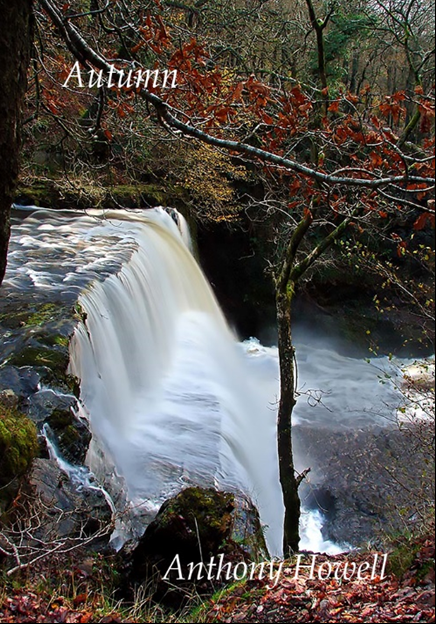
It would be erroneous – and stupid – to say that cracking the spine on Anthony Howell’s Autumn is as daunting as settling down (or, equally, squaring up) to The Odyssey or the Inferno or Paradise Lost, but I certainly gave that boxer-entering-the-ring roll of head and shoulders that characterised my approach to, say, John Ashbery’s Flow Chart or Frank Stanford’s The Battlefield Where the Moon Says I Love You.
I invoke the Americans because Howell shares much of his aesthetic with them, particularly a refusal to rule out anything as the raw material for poetry, not matter how quotidian, prosaic or even ostensibly vulgar.
Not that the comparison entirely holds. Autumn isn’t as freewheeling as either of those works, and its stanzas are formal and structured whereas Flow Chart’s are longer than freight cars on a half-mile-long train racketing through the panhandle and The Battlefield dispenses with them completely. Also, it’s perhaps only half the length of Stanford’s epic.
Autumn is still pretty damn long, though. It consists of a sequence of daily observations, presented almost as journal entries, from 18th September to 21st December, in the early Nineties, unfolding across something in the region of 1,300 quatrains – a good 5,200 lines of poetry. Maybe a little more. My figures are guesstimates.
It would also be erroneous – though arguably not quite as stupid – to describe Autumn as a narrative poem. Granted, a sort of shaggy narrative emerges, sometimes elliptically, sometimes pugnaciously, but narrative isn’t the point of the poem. Close observation is. The close observation of objects. Autumn commences on the aforementioned 18th September with a focus on a portfolio containing “seven charcoal drawings”:
Each is just below a metre square,
And vigorously worked on cartridge paper.
All are sketches of a huddled figure
With a second figure rising out of it
Though rooted to the same place by the feet,
Both otherwise at liberty to twist,
So long as this contortion fits the square.
Thus the object is studied in detail, the reader learning vastly more about it than the artist or those viewing it. A week later we have a coolly observed scene of eroticism in which the participants are unnamed and the lady’s “candidly translucent / Shirt from Kenya” comes to embody all the tactile and exotic qualities of the act itself. Of the shirt, we discover in particular that “Its buttons are of cotton knots, and she tells him // It’s her mum’s”. I quote this for the benefit of any armchair Freudians.
The translucent shirt isn’t the only garment to get its dozen or so stanzas in the sun. Raincoats, leather jackets, ties and a whole wardrobe cherry-picked from a charity shop get the forensic Howell treatment. As do books, photographs, music stands, polished table tops, purses, bottles of perfume, bedsheets, VCRs, exercise equipment, kitchen utensils, even some portable gizmo which Howell riffs on for a couple of pages without finally identifying – a marvellous joke in a book where humour often hides in the weirdest of places.
None of which should suggest to that Autumn is a collection of still life descriptions – a literary display cabinet. Some of his objects aren’t even objects in a traditional sense: there’s an arthouse movie which with his characters intellectually engage, and a warren of streets named for metallurgy through which a character moves. Vehicles feature, emphasising Autumn’s sense of movement; of the expended energy of lives lived in the moment even if that moment is banal, unfulfilling and barely worth said energy.
There’s also the via negativa of objects stolen during a campus break in.
Over the first few entries, this aesthetic plays out as an interesting experiment in form, content and technique. Then it becomes immersive. I found myself, within just a couple of days, eager for a break at work so I could dip into it for another half hour or so, and resentful when time was up and I had to set it down again. By the hundred page mark, I was frankly astounded at the degree of sustained creative imagination on display.
Autumn is entirely its own thing, a quietly mesmerising account of a time (the Nineties) and demographic (academia) that could easily have got lost in a so-far-so-Kingsley-Amis unspooling of rivalry, complacency, middle class pretentions and sexual shenanigans, but uses the steadfastness of objects to render the all-too-human a little more nuanced and intriguing. It understands our foibles and failures, and forgives us our sins.
Neil Fulwood