







Read any good verse novels lately? Personally, I can’t think of anything truly outstanding in that most challenging of verse forms since Robin Robertson’s The Long Take, published seven years ago, and Anne Carson’s Autobiography of Red from 1998. Indeed, the verse novel currently seems to be the province of Young Adult writers, with the likes of Jacqueline Woodson’s Brown Girl Dreaming and Elizabeth Acevedo’s The Poet X finding favour with the critics and introducing school-age readers to a style of narrative fiction they would not have experienced before. And kudos to any author who makes poetry interesting to a new generation.
But for adult readers – moreover, adult readers in search of something stimulating, challenging and fiercely committed to form and structure – the pickings have been slim to the point of anorexic.
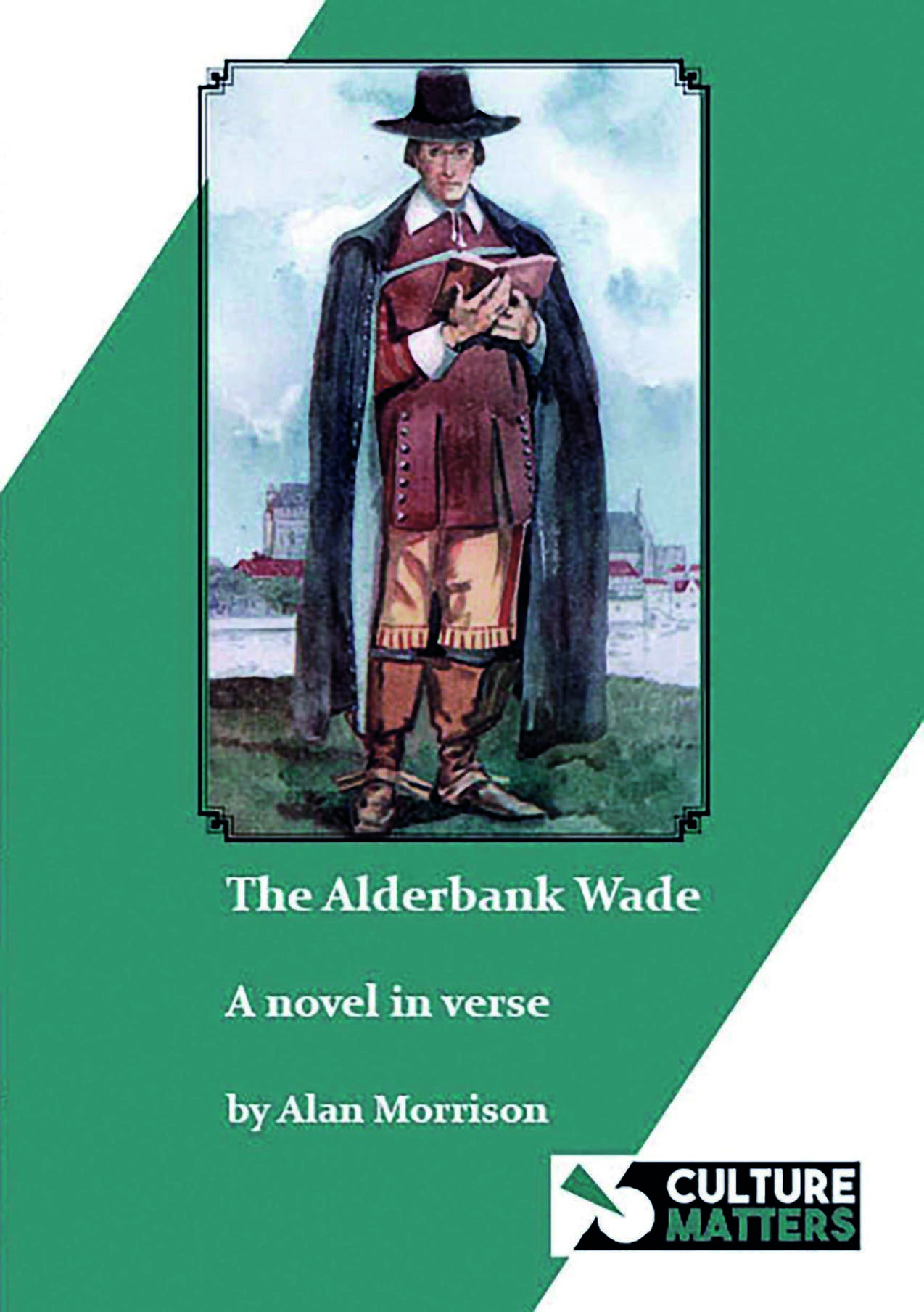
Hallelujah, then, for Alan Morrison’s The Alderbank Wade, which is not only the most assured and intellectually satisfying verse novel since The Long Take, but consolidates Culture Matters as perhaps the UK’s premier publisher of radical, socially progressive and truly working class poetry. And in a skeletal literary landscape left even bleaker by the closure of Andy Croft’s Smokestack Books and the uncertainty surrounding the future of Shoestring Press following the death of John Lucas in September, it may be that only Culture Matters remain to carry those particular standards.
But these are musings for another article. The Alderbank Wade is our present subject, and the first thing I’d put to anyone approaching it is: how much do you know about the English Civil War? If, like me when I turned the first page and started reading, your answer is “um, Roundheads and Cavaliers” or the fact that you saw Cromwell or Witchfinder General back in the day, well … that’s a start. But have a browser open to a search engine as you read, and be prepared to scour library or bookshop afterwards (the list of sources cited by Morrison as part of the introduction is an excellent starting point).
This isn’t to say that Morrison trades in obscurism or writes only for a niche audience. History was one of my worst subjects as a schoolboy (there was something about the litany of kings and queens and ancient battles that made my mind pull down the steel shutters) and even as a more enquiring adult, most of my non-fiction reading has encompassed twentieth century history). It’s to Morrison’s credit that he has conjured, from historical material I have no personal interest in, a literary work I found utterly fascinating. A work that has inspired me to further reading.
The Alderbank Wade is narrated in rhyming or slant-rhyming couplets, Morrison’s long fluent sentences often unravelling through entire cantos. His use of language – its rhythms and nuances, its propulsiveness – is masterful, his poetics shot through with confidence. In an astoundingly sustained 120 pages, I counted perhaps three instances where a line seemed shaped by the requirements of the form rather than being effortlessly organic.
Narrated in the first person by Jared Amory, an Everyman figure who observes and explicates, the actual protagonist is Gideon Wade, whose notoriously earned appellation “the Alderbank Wade” gives the work its title. Jared, a messenger during the conflict, is reunited with his childhood friend Gideon when the latter switches allegiance from Royalist to Parliamentarian and founds a Leveller community at a captured property, Alderbank House.
I’ll not go any further into a plot synopsis lest this review bespatter itself with Letts’ Notes style footnotes or parentheses; besides, the psychological reconfiguration Gideon’s volte faceentails is the meat and bones of Morrison’s narrative. If Jared is Everyman, Gideon approaches something messianic, bristling with the fervour of the recent convert, a man who has
… travelled in heart,
Mind & spirit, from Royalist trooper, through
Defection & enlistment as an Ironside, a true
Model Roundhead risen to the rank of Captain, as one
Of the most evangelical of ‘Levellers so-called’ …
But of course, men of Gideon’s zealotry are anathema to the establishment and forces begin to move against him, the narrative building to a denouement of cinematic intensity.
The Alderbank Wade packs considerable literary and historical heft. It drills deep into its main character’s psyche as well as bustling its narrator through a thorny emotional arc. It evokes a time and a place, setting finely chosen minutiae against a sweeping landscape. Tautly controlled and deftly structured, it is a considerable achievement.
Neil Fulwood
https://www.culturematters.org.uk/cm-publications/books/the-alderbank-wade-a-novel-in-verse/