

Here are some of the things Performance fetishises:
- Mick Jagger’s lips
- James Fox’s lower back and arse
- Anita Pallenberg’s nipples
- Michèle Breton’s androgyny
- dirty bath water
- the paintwork of a Rolls Royce (until it’s anointed with acid, that is)
- mirrors
- recording, mixing and amplification equipment
- pop art posters
- shitty basement rooms
Performance is about a lot of things, principally the merging and blurring of identities. With a specific focus on sexual identities (today’s word on Sesame Street is “troilism”). It’s about machismo and fragility; brutality and camp. It’s about the underground and the underworld. It’s about cufflinks and cross-dressing. It’s about class and counter-culture. It’s The Servant on magic mushrooms. It’s the film Saltburn wants to be when it grows up.
It’s an astoundingly well-constructed amalgam of gangster thriller, social satire, sex ‘n’ violence exploitationer, and psychedelic headfuck.
It’s also – please redeem your Lucy Spits On An Icon outrage voucher here – a little bit crap in places.
There’s the whole evocation of the East End gangster milieu. Performance was released in the UK in January 1971, just over a year after the Swinging Sixties came to a bloody end at Altamont, and two and a half years after the Krays had been arrested (they were still heroes to many). The great train robbery and the Profumo scandal were still lodged in the public consciousness. All roads – in London, at least – seemed to lead to sharp-suited bovver boys with shooters and shivs and flash motors.
And yet Performance gives us a cluster of paunchy British character actors who look about as hard and dangerous as chartered accountants. Maybe this was writer and co-director Donald Cammell’s intent: the seedy club/shadowy backroom/mini-cab firm sphere of operations they inhabit is constantly referred to as “the business”. And their veneer of pseudo-respectable businessmen is savagely subverted in the legendary ‘Memo from Turner’ sequence.
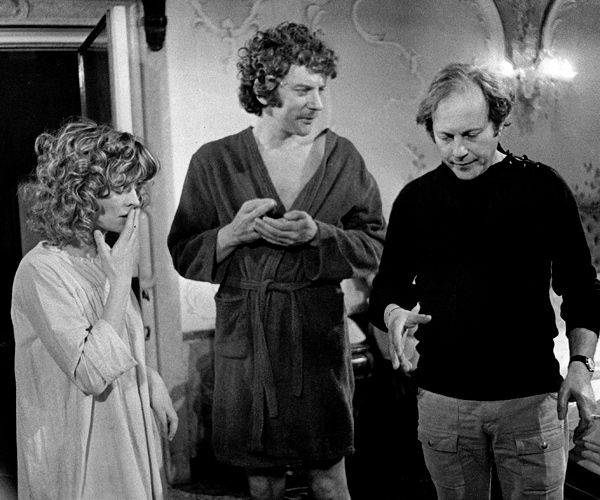
For all that these middle-aged blokes look like they’d struggle to take a free kick in a Sunday afternoon five-a-side let alone dole out a kicking, Cammell and co-director/cinematographer Nicolas Roeg revel in violence, literally painting the walls red as characters are punched, kicked, whipped or shot. It’s a film of juvenile sadism and almost pornographic sexual intensity, in which the strongest word uttered by any of its characters is “twerp”. Compare this to the hard edge and urban verisimilitude of The Sweeney, which debuted four years later in 1975, with its litany of “slag” (sometimes used in a non-misogynistic sense, believe it or not), “filth”, “pigs”, “bastard”, etc and entire chunks of Performance’s dialogue track sound more like outtakes from Z-Cars.
Then there’s James Fox’s characterisation of East End enforcer Chas. Here we have British cinema’s quintessential posh boy striving to sound like a cockney but ultimately delivering lines like “you’re a comical little geezer” in Received Pronunciation. Granted, he aces it in the film’s second half where the gangster stuff is demoted to subplot and what unfolds is a study of sexual ambiguity. Which brings us to …
Performance’s sexual politics. I can only imagine that it was a controversy magnet back in 1971. Today – post-Matador, post-The Brown Bunny, post-A Serbian Film, post-Blue is the Warmest Colour, when half of the content on Netflix shades towards Pornhub – it comes across as dated, adolescent, lacking in nuance. Daring and transgressive have come to mean something jarringly different fifty-five years down the line.
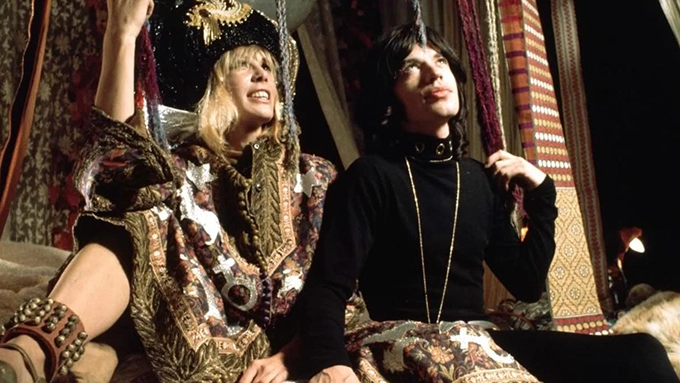
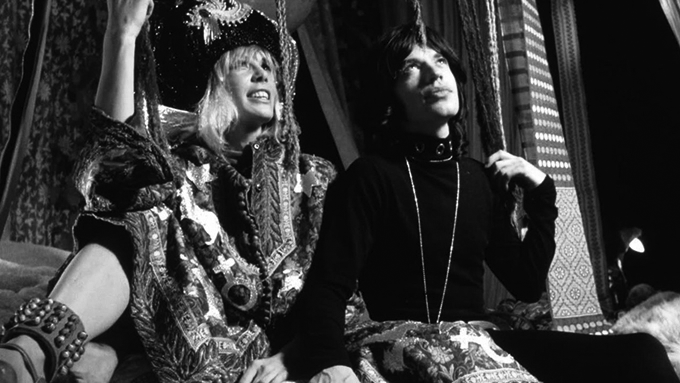
Where it does score highly, though, is in its cluster of better-than-you’d-expect performances. Jagger, usually awkward in acting roles, is in his element here. Pallenberg is a force of nature: wild, mocking, erotic. Michèle Breton – whose life story would make a film infinitely more deranged and provocative than Performance – is extraordinary: ethereal, impish, The Tempest’s Ariel as a sexual free spirit.
And it’s fascinating to identify the stylistic quirks, frenetic visuals and thematic preoccupations that Roeg would unspool through Walkabout, Don’t Look Now, The Man Who Fell to Earth, Bad Timing and Eureka (and some of which would still be floating sneakily around in The Witches), and those which Cammell only got a precious few shots at building on in a criminally underpopulated and tragically curtailed filmography.
Don’t get me wrong: I have a lot of time for Performance. It has moments of brilliance. The frisson of the mirror scenes. The fractured editing. Jagger’s full tilt delivery of the key line – “the only performance that makes it, that really makes it, that makes it all the way, is the one that achieves madness”. The deconstruction of Chas’s identity and sexuality. The sheer amount of running time given over to fetishisation. The reimagining of movie camera as a leering, lurid creature from the id. And did I mention ‘Memo from Turner’? There’s a reason it’s my favourite Stones track.
That it has its fair share of flubs, that it emerges as so dated in certain ways, that for all its feverishness it doesn’t really add up to much beyond the immediacy of a specific cluster of scenes – the wonkiness of Performance is what makes me love it. The fact that it makes me laugh when I’m pretty damn sure that’s the last reaction Cammell and Roeg wanted.
Lucy Bellingham