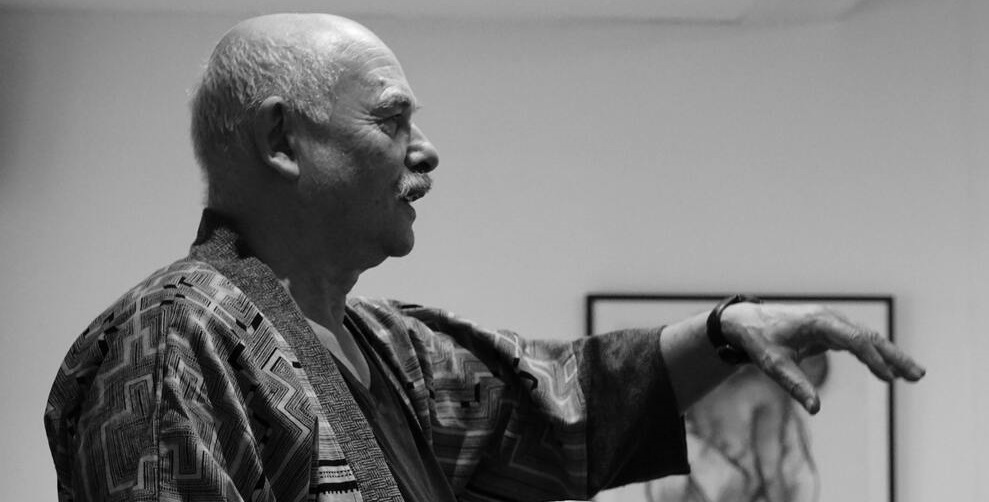
CHAINLINK: On the spine of your book-length poem Autumn, where the publisher’s name and/or logo would usually be, it says “Manubook”, which I take to mean a manuscript presented bound and with an illustrated cover – for all intents and purposes, a finished project. Is the “Manubook” concept of your own devising? Can you talk us through the thinking behind it?
AH: Yes, it was conceived as a manuscript presented bound with a cover; a response to print-on-demand availability. I have done three of them: Autumn, Peire and Lunete (a novel describing a contemporary love affair as if it were happening in the Cathar period of the troubadours in Provence), and The Best Deborah Stories – a portrait of my mother in two parts – before I was born and after I was born. This last manubook has proved rather popular. More recently I developed Grey Suit Editions as a publishing house (it began in the 90s as a magazine on video – unique for its time – and featuring poetry, performance art and experimental film). There is a website through which one can access all thirteen hours of Grey Suit’s video as well as the list of our publications –

Autumn is a significant and weighty piece of work. It’s long; it cleaves to a structure and a rhythmical pulse from which it does not deviate for the entirety of its 273 pages. Did you envisage it as thus from the outset, or did it grow from humbler beginnings?
I began it by writing a long page of a notebook, filling that page every day with a description of the salient object of the day before. This took the whole of that autumn to complete. I was interested in describing the minutiae of a sector of existence. But I have always been attached to the notion of formal discipline (I began my career as a ballet dancer). So for the next two years I worked hard at rendering each page in formal stanzas. I’m not saying I knew that I was going to do this when I started out. I am always guided by my process which has a wide remit – from explicit “confessional” to abstract formal structuring. Such emotional expression fused with formal constraint is apparent in the work of The Theatre of Mistakes – a performance art company I founded in the late seventies with Fiona Templeton –
https://theatreofmistakes.wordpress.com
Ultimately, I believe that a musicality is conferred to the content, a sense of aptness, through the metre that is used. I find the same fusion of emotion and formality in the music of Handel or Bach.
One of the first things that struck me about Autumn is the frankness of its depiction of sexual behaviour. There’s nothing rarefied or artsy going on here, no hiding coyly behind the allegorical. The tactile, physical and sometimes messily awkward reality of things is front and centre. It’s worlds apart from the buttoned down approach that a lot of modern poetry takes. Was it a conscious decision to embrace the explicit?
It was simply a forensic interest in getting down the detail of whatever the salient object happened to be. If that object happened to have a sexual aspect, that was what would get described. This brings up the issue of description in my work and why. These days, I would locate my writing as attempting to achieve a balance between abstraction and narrative – calling into question the notion of meaning – which is a slippery thing, in my opinion. After my initial publications, I became involved in the notion of abstract poetry – as pioneered by Gertrude Stein, but also explored by Wallace Stevens. I knew John Ashbery well, and Clark Coolidge, and felt very attached (at a distance) to the New York School. I appreciated Ashbery’s mellifluous verse which vanished behind you as you continued to read. But quite obviously Ashbery could not be imitated. I came to realise that the deeper issue in modernism (as we considered it back in the seventies) was not so much abstraction as a seeming absence of significance. The narrative poetry of the establishment was remorselessly significant, meaningful – as championed by F.R. Leavis. But that is essentially what modernism opposed. This can be seen very clearly in the work of Raymond Roussel and Italo Svevo. I realised that if I focused on description, especially description of those insignificant objects and procedures that epitomise the everyday, I could achieve mellifluous, Miltonesque sentences without sounding like Ashbery. F.T. Prince’s book on the Italian influence on Milton is relevant here – and Prince was one of the few poets Ashbery acknowledged as an influence on his own work. Dipping into Autumn today, I am taken aback not so much by the sexual frankness as by the obsession with appearance – hair dye, overcoats etc.
Although in no way a narrative poem, a narrative of sorts does emerge from Autumn via the accretion of quotidian detail and the centrality – and sometimes interplay – of objects. Did you reject anything as too banal or ordinary, or was there poetry to be made from everything?
I rejected nothing that had struck me as an aspect of the salient object of the day before (which also included the night). It could be a dream or a fart. I strongly believe that poetry can be made from everything, and this has caused considerable friction in my career. Michael Schmidt dismissed my long poem ‘Boxing the Cleveland’ as being on a subject below the “dignity” of poetry, unworthy of verse and so on. Since Carcanet took over the backlist of Anvil, who had been my publisher, this led him to tell me emphatically, you will never be a Carcanet poet. But then, what about Dryden’s The Rape of the Lock? And you are right, an ironic narrative does seem to emerge, even in the description of food and its later digestive effects; but in no way was I in control of that narrative.
You have an impressive roster of publishing credits – as poet, novelist, editor, essayist, etc – dating back to the late Sixties. How does the UK literary establishment now compare to the way things were fifty or fifty-five years ago?
The first thing to say is that there were fewer of us. This is well expressed by Robert Archambeau (now editor of The Fortnightly Review) in his 2011 article on “The Problem of Multitude”
https://samizdatblog.blogspot.com/2011/12/10000-poets-problem-of-multitude-in.html
Back in the sixties, I knew, or knew of, most of the sixty-odd poets in the UK – whatever their style and irrespective of whether I agreed with their view of what poetry might be. So I met Geoffrey Hill and I liked to argue with Michael Horovitz. Another thing I would say is that, back in those days, younger poets tended to admire older poets. I was a huge fan of William Empson. The entire artworld was a smaller entity – I went to the private views of a fair number of the visual artists of the time, knew most of the composers – Michael Nyman, Philip Glass, John White and others, as well as the jazz musicians and the dancers. It was possible to gather a geographical sense of how things were constituted. It enabled dialectics: there were dynamic arguments that we all took part in – figuration versus abstraction, communism versus the market. The brilliant comic writer Marvin Cohen was a frequent visitor from New York (now published by Sagging Meniscus, though sadly he died this year), and I often visited the States where Marvin and I would hobnob with Wallace Shawn. Men and women were all equally part of these discussions. I admired Jean Garrigue, Elizabeth Jenkins and Fleur Adcock. Sylvia Plath became hugely popular, though one might take issue with a trend towards hysterical confession. I certainly did, but then my interest in confession related more to the work of Andre Gide and immoralism, a thread that I have pursued throughout my career. I should also point out that I was young. I had champions. Robert Nye and Peter Porter and George Macbeth promoted my work. Olwyn Hughes and Marion Boyars and Barbara Bray all urged me on. For me it was an encouraging time.
I’m particularly keen to track down a copy of Imruil, your free translations from pre-Islamic Arabic. What was the impetus for that project, and what challenges did the translations pose?
I have never called my work on the poems of foreign authors “translations”. I have always referred to these as versions. I reserve the right to be free to turn a poem in another language into the best poetry I can make out of it in English. I found a prose crib of Imr-al-Kais in a book of essays presented to the anthropologist C.G. Seligman – which R.S. Rattray had translated from Hausa – which had been done into that language from the Arabic by a Gold Coast scribe. So the crib on which I based my version was already a translation of a translation! This is why the book is called Imruil – which is how the Arab poet’s name had been converted into Hausa. I think Frederick Seidel may have seen Imruil – he is certainly an admirer of Imr-al-Kais. Since then, I have done the poems of Alain-Fournier, and some of Statius, and two books by the Iraqi poet Fawzi Karim – who was a great friend of mine and we worked together on the poems. I’ve also got a flip book link to Amphorae –
https://heyzine.com/flip-book/d8ad08baca.html
a selection of versions I have done including quite a few of the wonderful impressionist poems of Anna Comtesse de Noailles – who was, in her day, more popular than Colette. She has now been virtually forgotten. John Ashbery once told me that he preferred discovering writers (and artists) who were off the beaten track, and that he liked exploring the byways of literature. This has been a guiding principle behind how I choose who to translate.
You formed The Theatre of Mistakes in 1974. Where did the name come from, and can you tell us more about the group and the performances it has given?
The name came from the process. We worked on performance exercises. Sometimes these clashed when performed in conjunction with each other. Accidents could occur. We believed in being not acting. And we often worked with functional movement. I have given the website link in an answer to a previous question. There is a video of a performance called Going – which was recreated at Raven Row gallery a few years ago. We performed in Paris, sharing the FIAC venue with Robert Wilson, and we created double bills which we toured around Belgium and the Netherlands with the wonderful performance artist Stuart Sherman. We performed at the Theatre for the New City in New York and at the Paula Cooper gallery, and we performed for a whole summer at the Hayward with a piece called The Waterfall. I then went on to have a solo career in performance art, performing and teaching in Australia, Germany, Serbia etc. Several of my own performances can be found if you scroll down on this website link :
https://www.anthonyhowell.org/Reading.htm
I understand that you toured Serbia, Macedonia and Montenegro in 1997 in association with the British Council. How did that come about, and what was your experience of those places?
Well, back in the day, the British Council was a great patron of the arts, sending UK artists abroad as part of their cultural programmes. The British Council organised our tour of New York and Baltimore and to Berlin. But Serbia is special for me. I performed there many times when it was Yugoslavia, first with The Theatre of Mistakes, then with my own solo performances, then with a company I created called Tango Art – a fusion of tango and performance art. I also did a solo performance on the terrace of the museum in Skopje. There is a video of it somewhere, but I have mislaid it. There are also performance journals and texts. My second wife was from Serbia. People have said of my career that I always did better abroad than I did in the UK, and to some extent this is the case. I created a highly successful performance in Saint Petersburg in the late nineties, bringing horses back into the Imperial Riding School for the first time since the Revolution. There is a video of that performance on the link above. NATO should be disbanded. I think the destruction of Yugoslavia was a tragedy, as was the destruction of Libya. I have also written a book about living in Serbia called Serbian Sturgeon – which describes the artistic scene in Serbia some thirty years ago.
Serbia was at the forefront of Conceptual Art when Conceptual Art began. Marina Abramovic comes out of that stable, as does Tanya Ostojic. Unfortunately my book was pulped by Routledge when they took over Harwood Academic Publishers, the original publishers of this book and my performance book The Analysis of Performance Art – which is still in print. I have the remaining copies.
You were the editor of Grey Suit, a quarterly journal published on VHS. How did that work and how different is it presenting work in that medium as opposed to a print or online magazine?
The entire thirteen hours of videotape – originally published on VHS but edited on Umatic and Beta masters – was digitalised by the BFI and can be found on this link – https://greysuiteditions.org/about/grey-suit-catalogue
This was in the days before the internet. Having a video magazine was a unique way of watching the sort of performance, poetry, video footage now readily available on YouTube or Facebook or Rumble. So there is
footage of poets reading which cannot be found anywhere else – F.T. Prince for instance. I have always been interested in platforms which feature the work of artists of all genres – Wallpaper Magazine was a magazine with Wallpaper covers which I did with artists such as Anthony McCall, Susan Hiller, Andrew Eden, Susan Bonvin, and poets such as John Welch and David Coxhead – as well as composers and film-makers. That was back in the early seventies. We were all the editors, and you could get into the magazine only by giving up your own slot! It ran for eight issues.
Finally, what are your thoughts on the current state of the arts in the UK?
Modern abstract art has moved on from minimalism to a baroque stage – a sure sign it is entering its decadence. Scale has no relevance, as it did for the pioneers of abstract expressionism. So a lot of work in visual art is simply magnified decoration – required because the spaces are so huge and they have to be filled. The problem of multitude, referred to in Robert Archembeau’s 2011 essay mentioned earlier, has drastically worsened in the last decade. Unfortunately, writing is the most convenient of all the arts since all you need is a pen and a notebook (well a mobile and a voice app) so creative writing courses expand like malignant cancers. Cash-strapped universities now cater to students who are their clients, so what is taught is what the market demands – which is wokeness accompanied by trigger warnings. Read Julian Stannard’s very funny satire The University of Bliss. Personally, I am no longer interested in “modern” art. The term “modern” was first used by George Meredith in his sonnet sequence Modern Love in 1862. It sort of meant “Today” – as in “Love today” – and it’s a wonderful sequence of 16 line sonnets that attempts to deal with the reality of an affair. You could call it Nowism. The problem is the “Now” keeps changing, as do the meanings accruing to words – mouse for instance. Next, you get the meaningless conjunction of “post-modernism” – after nowism. My view is that modern art is completely finished. Face it, in art a cliché is a sin. Modern art has become a cliché. You cannot abstract from an apple tree in the manner of Mondrian. It has been done. It has been done to death. So bollocks to Pollock, abstract expressions etc. Far more interesting these days is to look at the paintings of Victor Hugo or Alexander Cozens. I call what they do “Deep Art”. Deep Art may have been anticipated by the surrealists, though it is actually earlier than surrealism. Basically it is going in the opposite direction to modernism. A work of deep art begins with some involuntary chaotic action, splotches, blots, found chaos, even a confused photograph, then works into that chaos to attempt to get somewhere; not necessarily to a figurative result but to a feeling of resolution in the artist’s mind. Deep art is a departure. It is alchemy. Its primary aim is for the artist to lose consciousness of the self in the engrossment of making art. This reminds me of Leonardo da Vinci’s advice: to look at a wall – at its blotches and imperfections, and see what image you might discover there. Deep art is done as a form of personal meditation. This is the only response to an “artworld” flooded by ambitious practitioners. That artworld only admits of a canon of megastars. Maybe twelve big names at any time. And that is inappropriate for the reality of the “multitude” – of the vast number of writers and artists that there are in our world today. There is also a special sublimity about deep art – particularly as applied to Victor Hugo’s paintings. This is to do with the sense that they work with suggestion, that they never result in a completely figurative image. Deep art has “depart” buried with in it, and this in turn links to the notion expressed in such books as Post Growth – Life after Capitalism by Tim Jackson and Less is More – how Degrowth will Save the World by Jason Hickel. The notion that we can survive and still grow the GDP is called into question by these books. This does not necessarily mean that we all adopt the way of life of the Amish – though the current persecution of Amish communities is an indication of the crisis we face. But somehow we have to learn to subsist without expansion. How do I see this in poetic terms? Well, I like to view writing in an ahistorical way. I am as interested in Richard Lovelace as I am in Frederick Seidel. I think of recreating an adage mentioned by Erasmus as a poem. Turning one of the Sylvae of Statius into English verse interests me, just as it interested Drummond of Hawthornden. Deep art suggests to me that poetry should not aim for today as much as it should aim for a certain timelessness.
Neil Fulwood was in conversation with Anthony Howell
Anthony Howell is a poet, novelist and performance artist, whose first collection of poems, Inside the Castle, was published in 1969. He has since published 17 volumes of poetry (among them translations and a Selected Poems). His most recent collection is Silent Highway (Anvil, 2014), of which one reviewer remarked: ‘These are elegant poems which demonstrate Howell’s talent for avoiding the predictable and deconstructing the recognisable’.
Further information: