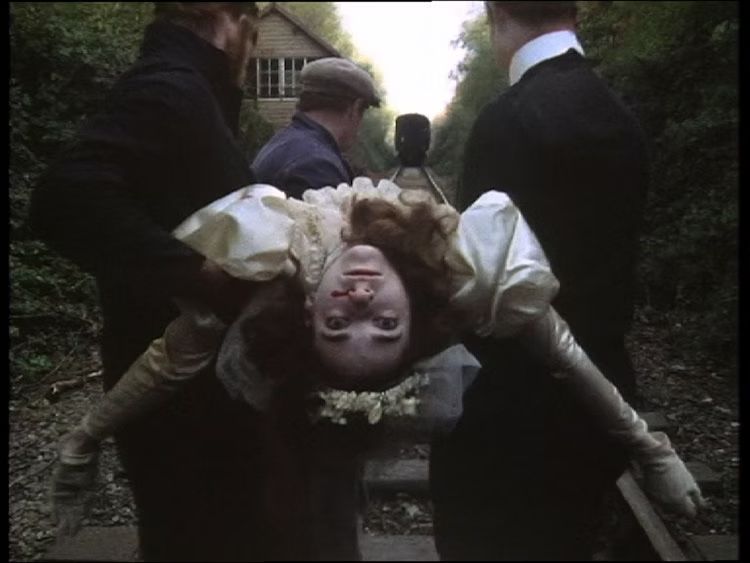
Christmas, 1971: the BBC enters its golden age. As the new-fangled colour service opens up to an expanding television audience around the United Kingdom, ‘Auntie Beeb’ fills the schedules with a range of drama, light entertainment and specialized public service orientated viewing which would make the ’70s the greatest in the Corporation’s history.
Jon Pertwee is the new Doctor Who, Peter Gilmore splices the mainbrace in The Onedin Line, the Hammond family are on the road in The Brothers while Keith Michell and Glenda Jackson bring the Tudors to life as Henry VIII and Elizabeth I in award-winning all-colour costume dramas. Top of the Pops, Basil Brush, The Generation Game and The Good Old Days proffer all-round family entertainment while trail-blazing documentaries like Civilisation pave the way for The Ascent of Man, Life on Earth and Connections among other legendary productions which would define the art of quality television for the rest of the decade.
And for this first Christmas schedule of the BBC decade, Michael Aspel presented cartoons, Ken Dodd sang songs, Billy Smart brought his Circus to town, The Black and White Minstrel Show featured hideous makeup, Cilla Black starred in Aladdin, and Andre Previn and the LSO joined Morecambe and Wise to play the Grieg Piano Concerto (by Grieg with all the right notes not necessarily in the right order), as the television climax of the Season.
Most of these fortunately, with the exception of the annually repeated Previn/Eric & Ernie special, pale in significance by comparison with a much quieter but ultimately legendary BBC tradition which continues – with variable quality – to this day: The Ghost Story for Christmas.
Enter Lawrence Gordon Clark, an accomplished BBC documentary director from the 1960s, itching to move into drama. Armed with a copy of the ghost stories of his favourite author, M.R. James and inspired by the template of Jonathan Miller’s iconic 1968 Omnibus adaptation of Oh Whistle and I’ll Come to You, My Lad starring Michael Hordern, Clark met with BBC 1 Controller, Paul Fox, with a view to adapting for television a cycle of ghost stories capturing the great oral tradition of telling supernatural tales at Christmas. Fox, realizing how the proposal could fall in with the huge popularity of small screen costume drama, gave Clark the go ahead, with a limited budget of just £8000 to make what was the first of a cycle of five M.R. James adaptations – The Stalls of Barchester.
Filmed entirely on location in and around Norwich, with its great cathedral and its environs the perfect Gothic backcloth, The Stalls of Barchester – starring Robert Hardy – set the stylistic template for the following four instalments. Using 16mm film, for night shoots and dark interiors, Clark cleverly avoided the then awkward visual transition from external celluloid to studio VCR footage which was often the bugbear of television dramas of the time. Eschewing the pyrotechnics of big screen horror movies, which he felt the small screen would fail to properly accommodate, Clark rejected blatant shock for subtle chills instead; therefore achieving a literary as opposed to a cinematic treatment of the story.
Fifty five years on, you can see and hear how well Clark’s treatment has succeeded. The Stalls of Barchester, with its story of how an overambitious Archdeacon’s murderous scheme is undone by an unforeseen supernatural power, continues to enthrall and unnerve us today. With its clever fusion of decorum and restraint, Clark’s adaptation of The Stalls of Barchester only reveals the true horror of the tale until the last possible moment, filling our imaginations with the suggestion of a ghostly presence as opposed to visual excess or aesthetic abjection.
Originally broadcast on Christmas Eve 1971, The Stalls of Barchester received great critical and audience acclaim, with Clark promptly returning to Norfolk the following February to film the next instalment, A Warning to the Curious, scheduled for the Christmas Eve of 1972.
Once again, Clark’s clever use of locations – spooky churches, desolate beaches, spiky malignant forests and simple but effective shadow play – delivers the tale of an amateur archeologist haunted by a mysterious figure in fine atmospheric style. The production, with a compelling central performance from Peter Vaughan and disturbing background music drawn from works by Ligeti, lifts this adaptation of A Warning to the Curious to new levels of subtlety, imagination and bleak, unassailable terror.
Following this second success, Clark was able to make the next story, Lost Hearts, under the wing of the BBC Drama Department, replete with a bigger budget. Moreover, the story would be scheduled for Christmas Day 1973, thus emerging from the shadows of the 24th of December into the higher profile and higher ratings arena of the 25th.
However, Lost Hearts, with its morbid tale of a rich orphan haunted by the ghosts of two children murdered by his outwardly avuncular uncle, made less of an impact and Clark’s next adaptation, The Treasure of Abbot Thomas, was scheduled for December 23rd 1974. This removal from the Christmas Day schedule was however, caused mainly by the commercial needs of the BBC, where light entertainment had become the corporation’s primary concern as The Two Ronnies and Michaels Parkinson and Yarwood augmented Bruce Forsyth and Morecombe and Wise to complete BBC 1’s unassailable domination of the UK television ratings.
But the Clark ghost story cycle continued. After The Treasure of Abbot Thomas – whose strong academic undertow might well have proved too esoteric for some – the series continued in 1975 with the disturbing spidery happenings of The Ash Tree before a break from M.R. James with Clark literally changing trains in 1976 to Charles Dickens, with a powerful and definitive adaptation of The Signalman.
In The Signalman, Clark’s misty, flame crackling adaptation and Denholm Elliot’s electrifying performance in the highly disturbed title role, combine to make the production the best in the series for many viewers and one of the best television ghost stories ever made. With more ambitious visuals than before and with its combination of restraint, cleverly staged build up and devastating climax, The Signalman is not just for Christmas, but a classic, timeless tale which can be watched, enjoyed and appreciated at any time of the year. Indeed, it can be viewed entirely separate from the rest of the series as a stand-along production in its own right: A fitting culmination of Clark’s pioneering work in the Gothic genre for small screen.
However, having reached Everest and the late 1970s, it was sadly a law of diminishing returns for the Ghost Stories for Christmas. Stigma, Clark’s last instalment of the series, telling the tale of a woman haunted by the spirit of a witch, was the first to be made in a contemporary setting. But the story lacks impact and the performances fail to ignite an already limited script. Following his departure for ITV where Clark went on to direct Casting the Runes, the quality of the series declined markedly. The Ice House, broadcast in 1978, telling the tale of the strange occupants of a health spa and the malign influence of a weird plant growing in the grounds, is just plain silly and the failure of the production effectively ended the ghost story series for the next 25 years.
Meanwhile, the fortunes of the televised Christmas ghost story waxed and waned with the decades. A number of low-budget Jackanory-style attempts were produced, including a short-lived series in 1986 featuring Robert Powell as M.R. James recounting his more famous stories to the camera with occasional illustrations and background music from Elgar’s first symphony. Then, in 2000, legendary Hammer veteran Christopher Lee took the reins, also playing M.R. James, but this time was filmed telling his tales to a gathering of prissy Cambridge students with low budget, low filter cutaways to gargoyles in Peterborough and grainy sands at Aldeburgh. Interesting in their way, these attempts were perhaps too outwardly contrived to merit repeated viewings.
Finally, in 2005 the newly fledged BBC4 launched a revival of the original 1970s series, along with a new M.R. James production, A View from a Hill. Returning very much to form, A View from a Hill, concerning a young archeologist haunted by homicidal spirits following his discovery and use of an antique pair of binoculars while researching monastic ruins, is a superb throwback to the Lawrence Gordon Clark years, and could well be attributed as a homage. Similarly, Number 13, broadcast the Christmas of 2006, has similar qualities of slow burn suspense and mystic photography, only obviated by a weak central performance by a camera-conscious Greg Wise.
After this however, it’s been downhill all the way for the Ghost Story for Christmas. A once eagerly anticipated annual event is annually undermined by a systematic lack of empathy, understanding and – yes, I’m afraid – talent. For example, a 2010 remake of O Whistle and I’ll Come to You, My Lad, is – despite the presence of John Hurt – a shadow of its 1968 remake with weak effects clearly modelled on The Shining.
Then, beginning in 2013, began a long and disappointing series of adaptations from television comedian Mark Gatiss which have continued ever since. Whatever knowledge and enthusiasm he has for the Gothic film and television genre, Gatiss simply fails to put this across in every one of the ghost stories he has directed. Babyish scripts, messy and erratic pacing, dull production values and laboured attempts to reference Hammer Films at every turn consistently reveal an inward, self-indulgent mindset. It’s as if Gatiss is like a child with free access to the sweetshop, happily acting out his fantasy as a horror film mogul. But none of it works. In his adaptations, Gatiss has taken out all the frightening scenes and left us with a series of interminable preliminaries only to stop suddenly and cut to the credits because he’s got bored with it all. If the only disturbing thing in the entire Gatiss series is Peter Capaldi in a full bottomed wig in the adaptation of Martin’s Close, I think it’s time to pack the whole thing in. Indeed, perhaps Gatiss may prefer to return to television comedy – he might just scare us then.
However, as another Gatiss production – this time of The Room in the Tower by E.F.Benson – is threatened for Christmas 2025 let us console ourselves with the happy return of the classic Clark adaptations on Blu-ray, due for release just AFTER Christmas (isn’t it always the way?) in a two volume set from the BFI. Meanwhile, the resources of Netflix and YouTube will yield many forgotten and unjustly neglected television ghost stories from down the decades to enjoy over the Christmas season, from The Stone Tape to Schalcken the Painter by way of The Turn of the Screw. So, during that blissful quiet time when the pre-Christmas hype is well and truly over, pour yourself a brandy, settle down in a darkened room and enjoy the ghost story of your choosing!
Robert Kenchington